Christ’s Redeeming Love | Part 3

 “And if Christ has not been raised, then our preaching is in vain and your faith is in vain… But in fact Christ has been raised from the dead.” 

1st Corinthians 15:12, 20

    
    Today is Easter Sunday.

    The day Christ rose from the dead two thousand years ago, conquering death and freeing humanity of the burden of our sins once and for all. The day that is so central to the Christian faith, for as Paul writes in 1st Corinthians, if the resurrection didn’t happen, everything we’ve ever believed is for naught. But the good news is, it is true.

Death, where is thy victory?

    The evidence for the life, death, and resurrection of Christ is the most documented of any religious or political figure in history. Multiple people have attempted to disprove the gospel accounts, and found only evidence for, not against. 

Death, where is thy sting?

    It’s the best news in the world and it’s true. What are the odds? But God loved—loves—us so much, He sent His one and only beloved Son to die for us. And He conquered death, once and for all. Not even death, that terrible and awful thing, can overcome the God of the universe. 

Death, thou shalt die. 

    He is risen!

____

Soli Deo Gloria,

Astrya

Christ’s Redeeming Love | Part 2

   Waiting.

    It’s so hard to wait, sometimes. We always seem to get caught up in the business and bustle of life, and forget to stop and think and wait for just a half-a-second. But that’s what today should be. A day of waiting, of reflection, of remembering Christ’s horrific and awesome sacrifice, of looking forward to His resurrection and the salvation that is to come. 

    How can we properly experience something so mysterious, so grand and wonderful, in a world that has forgotten to care? But we need to. Somehow, we need this day of waiting, to prepare ourselves for the miracle that is to come. 

    The disciples, despite having been told multiple times by Christ Himself what was going to happen, were yet clueless and had no notion of the hope they were about to be given. Instead they reeled back in astonishment and fear and disbelief. They had no choice but to wait—though for what they were waiting they had no idea whatsoever. 

    Sometimes we scoff and wonder, why didn’t they know better? Why didn’t they listen to what their Lord and Saviour told them? And yet we would have been no better. You or I, we’d have been just as oblivious, just as daft—and that speaks to exactly why we need a Saviour. We’re so lost without Him. We can do nothing of our own strength and expect to be saved because we are “good enough.”

    This day in between Good Friday and Easter Sunday, it allows us to dwell on that. On just how much we need God. On how much He endured for us, just because He loved us. And while the whole world is breathless in anticipation for the salvation to come, we can remember, and be thankful. 

    And as we move from the overbearing darkness of sin to the brilliant light of redemption, we dwell on His sacrifice. That the God of the universe was crucified for our sake. That He redeemed our souls by the sacrifice of His blood. Now that—that is something more than worth waiting for. 

____

Soli Deo Gloria,

Astrya

Christ’s Redeeming Love | Part 1

     Today is Good Friday. 

    It also marks the beginning of a three-post series I’ll be doing, one today, one tomorrow, and one on Sunday, tracing the ultimate redeeming love of Christ—His crucifixion, the terrible waiting feeling the apostles must have felt The Day After, and concluding with His triumphant resurrection on Easter Sunday. 

    The crucifixion and resurrection of Christ is the central theme of Christianity—the Hebrew Scriptures begin with the fall of humanity, the need for a redeemer, and the prophecies through God’s messengers of the hope that is to come. The New Testament begins with connecting Christ’s human lineage back to Abraham, and then to David. He is the promised Saviour of humanity. And you know what? He didn’t need to die. God didn’t need to save us. But He loved us too much, despite our sin, despite everything, to let us sink back so hopelessly into sin. And so He didn’t. He sent a Saviour—His Own beloved Son.

When he sees all that is accomplished by his anguish, he will be satisfied.” 

Isaiah 53: 11

    Sometimes in Christian circles we tend to celebrate Christmas in a grander, more extravagant way than Easter. And that’s okay, because none of this needs extravagance. But Christmas—Christ’s birth—incredible as it is, it’s just the beginning. 

    He came into the world to redeem His people.

    He bore all the sins of the world—the sins of the entire world—upon His shoulders. 

    And it’s because of his anguish that we can even live and do the things we take for granted every day. We can’t even imagine how much He suffered, not only physically but also spiritually.

    “My God, my God, why hast thou forsaken me?” This cry, this terrible tragic redeeming cry, offers us only a microscopic glance into what it must be like to know the wrath of God. Yet Christ took it on, took on the anguish, so that we didn’t have to.

    So that we didn’t have to. 

    His love for us is so great that He suffered beyond our worst imaginings to save us. That is redemption. That is love. And because he lay dying on that cross, crucified in body and soul, all we have to do to join Him in Paradise someday is to say, like the thief on the cross, “I believe.”

    I believe.

When Jesus had received the sour wine, he said, “It is finished,” and he bowed his head and gave up his spirit.

John 19:30

    It is finished.   

____

Soli Deo Gloria,
Astrya 

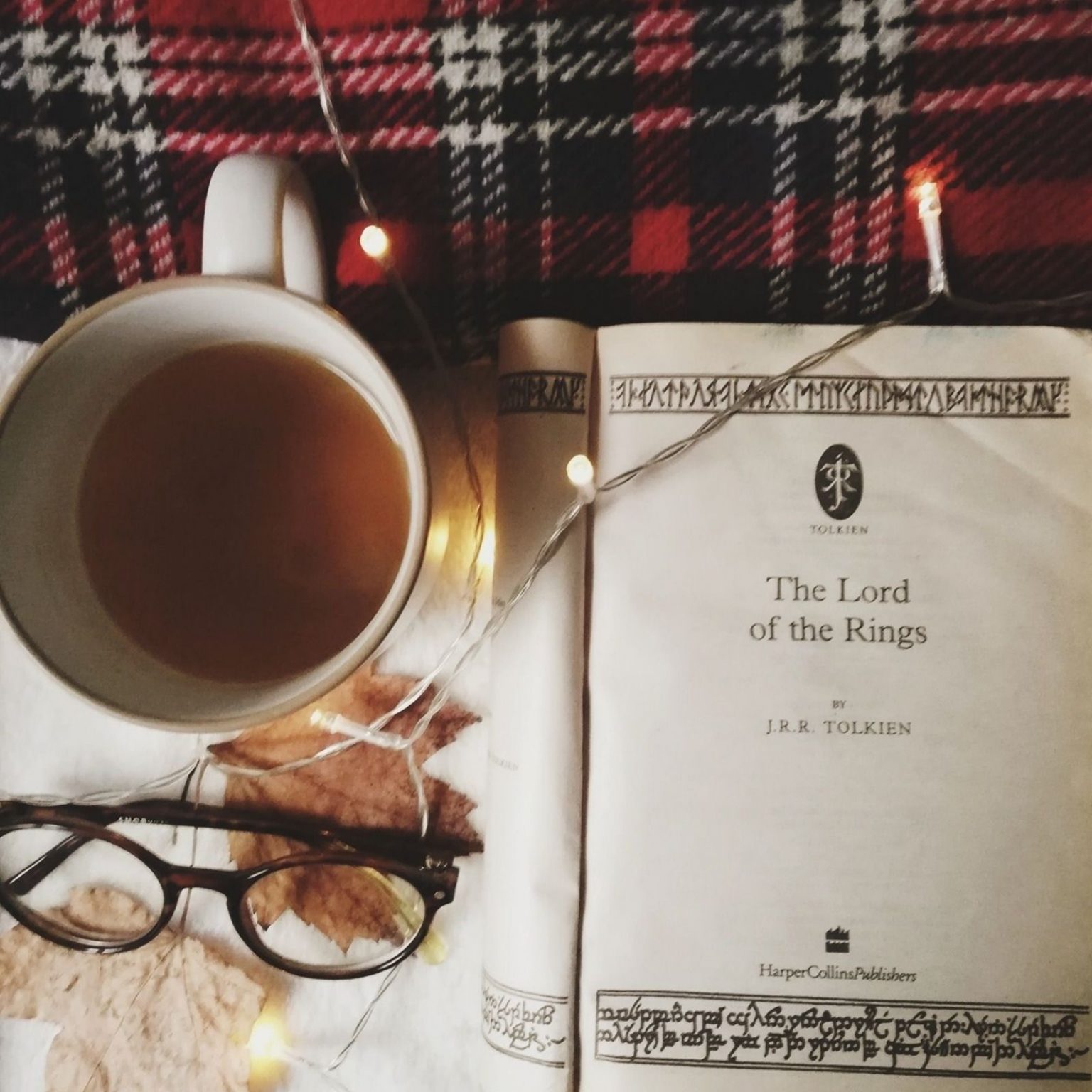
Tolkien Reading Day


    Today is a holiday. A most excellent one, in fact, if I do say so myself. 
    Now, if you’re a lover of J.R.R. Tolkien’s marvellous The Lord of the Rings, you’ll of course know exactly what I mean. But if you’re not as familiar with the Wonderful World of Middle-Earth, you might be wondering, “do you mean that it is an excellent holiday, or that it a holiday whether I want it or not; or that you feel like it ought to be a holiday, or that it is a holiday on which to be excellent?”
    And I say to you—all of them at once! For of course I have just borrowed an admirable quote of Gandalf’s to express your confusion, and of course today is a holiday. A rather remarkable one, in fact. 
    Today is International Tolkien Reading Day. 


    Wait, wait! Don’t cheer yet. We haven’t even gotten to the best part! I must first provide a Bit Of History so that we can adequately appreciate this day. 
    For those of you who are well-versed in your Tolkien Lore, March 25 will be well-known to you as the day of Sauron’s defeat (at the end of the Third Age). This of course is the reason why the day was chosen by the Tolkien Society to commemorate his works. It’s been celebrated in some way, shape, or form (usually by reading Tolkien!) since 2003, when columnist Sean Kirst suggested the holiday. (Mr. Kirst, I am much indebted.) 
    Aside from the obvious reasons—who wouldn’t want to read Tolkien?—it is, I think, quite important to recognise the truly great works of literature that can tell us so much about our society, humanity, and the way the world works. Now of course you’ll say, “but wait, this is fantasy!” And to that I say, “humbug!” (To quote the esteemed Ebenezer Scrooge.) 

    
    Of course this is fantasy. That’s why it can tell us so much. If you’ve read my last post, I discussed the implications and aftermath of Coming Home after bidding farewell to something or someone you love, in the context of The Lord of the Rings. How can you move on when it seems so impossible? 
    Well, great stories like this one can help us discern the answers to questions such as that. That’s why they’re so important. When we look at flawed characters like Boromir or Thorin, we can see the truth in humanity—that we all sin and fall short of the glory of God, but we can be redeemed. When we see the quiet strength in characters like Sam, or the grave dignity of Aragorn, we can see what true friendship really means, and what we ought to be like. These stories—they tell us so much about ourselves. And they give us hope! Because in the end, the Good Must Prevail. 

    These stories, at least for me, can lead us closer to God. By showing us another world, so different and yet so similar to our own, we can see the truth and beauty of creation and what God has intended for us. They are of course not the only thing we ought to rely on, but they can teach us more about our Creator—and more about ourselves. 
    That’s why Tolkien Reading Day is so important, at least in my humble eyes. And not just this one day, either but every day—every day on which we read a great story and discern greater truth because of it. 
    Anyway, thanks for “listening” to my little rant. I hope it serves you well somehow—and lothron i elena mír-oiale bo cín lond!*


____

Namarië, 
Astrya

*may the stars shine ever on your path!

Coming Home

 “It's a dangerous business, going out your door. You step onto the road, and if you don't keep your feet, there's no knowing where you might be swept off to.”
-J.R.R. Tolkien, The Lord of the Rings
   
    You may have noticed a couple weeks back I mentioned I’d gone away for a week. Well, I did—I went on a trip to the redwoods with fourteen other students and a few faculty members from my school. One week in the misty mountains reading and journaling our way through the greatest fantasy trilogy of all time: J.R.R. Tolkien’s The Lord of the Rings.


Nothing but the cold woodland air, a good book, good friends, English breakfasts, warm tea, chats around log fires late into the night. And it was one of the most phenomenal experiences I’ve ever participated in. 
But as incredible as that was, I’m not here to talk about it. Instead I want to talk about What Happens After. 

    There are so many hard partings in this life, the greatest of which is death. For Christians, death is not truly the end, but another path, one that we must all take. It’s not the end, it’s the beginning. But for those left behind when others go, remembering that provides only a small bit of comfort. Such is the way with all partings, really—earthly and heavenly. 

    Yet—how do you say farewell to something that you love? How can you put all that behind you, pick up the threads of an old life and move on when you’ve changed so much? Farewells are everywhere, and as we deal with the consequences of saying goodbye, we look to the stories and tales and memories that have changed us, that have given us hope. 

    Sam and Frodo went on the ultimate adventure, wandering the forests of Emyn Muil and climbing to the peak of Orodruín beneath Sauron’s very eye to cast the Ring into the fire. Yet it was not their own strength that sustained them, it was their friendship and their belief in something greater that kept them going. They feasted with kings and told stories by the firelight under the stars when it was all over—and it was never just Sam, or just Frodo, it was Sam and Frodo. 

They’d been through too much together for it to be anything else. When they returned home they fought off the remnants of evil that had chased them home to the Shire—and Frodo was war-weary, heartsick, and he wanted to go home. Yet his home was changed. The Shire had been saved for Sam, but it hadn’t been for Frodo. So he left. He left to heal, and he left to find peace. Sam was home. He wasn’t. 

    And so Sam and Frodo became just Sam again, and he endured. But that farewell was the most bittersweet he had yet endured, for it is the friendships that bear so much that are the strongest. Bonds that strong can never be broken. The entire Fellowship—it might have been ended, but it was not broken. And so they remembered, when they were alone, what they had endured—and though the end had come the beginning was just around the corner. 

    So how do you say goodbye? We have but once choice—to keep going, despite the sadness. At the end of our trip, our fellowship too had formed a bond, one too strong to be broken. And when the end came, we bade farewell regretfully, sadly, but knowing it’s not truly the end, not really. 

    So when I come home, and find it changed—or is it I who am changed?—I will not weep, for this adventure has not finished. Instead I’ll remember the good things and smile because it happened. I might not be Frodo or Sam or Aragorn or Éowyn, but I can remember their stories as I live out my own. They’re the kind of stories that stay with you forever. 

  Hope. Hope for the good times, and to endure through the hard. For a wonderful adventure, and a bittersweet ending. For good to prevail in the end. For Christ to return and redeem His people once and for all. 

    Coming home isn’t the end. It’s only the beginning. 

Isn’t this a beautiful quote?

____

Thanks for reading! If you have Thoughts, please let me know. I’d love to hear!

Namarië,

Astrya

The Sorrows of Young Werther | Part Two

  “It is decided, Lotte. I shall die, and I write this to you not in romantic fervour but calmly, on the morning of the day on which I shall see you for the last time.”

Johann Wolfgang von Goethe, The Sorrows of Young Werther


    So now we have come to it—the second and last of my posts on The Sorrows of Young Werther. Prepare yourselves, for chaos shall follow, because this book is objectively chaotic, and thus my thoughts are scattered. But first, for those who have not had the redoubtable pleasure of perusing this book, I must provide a Warning.
     
SPOILERS SHALL HENCEFORTH COMMENCE. READ AT YOUR OWN RISK.

    There, now that that’s out of the way, shall we get started?

    Chaotic is indeed an apt description for this book—as I mentioned in my last post, Goethe used part of his own life as inspiration for Werther’s lovesickness. But more than that, the sheer amount of Werther’s feelings and seeing them in full force is rather overwhelming. From the beginning, Goethe drops little hints as to what might happen at the end—and then it does. But before we get there, a little recap. 

    At the beginning of Part Two, Werther has returned home from Wahlheim, having been urged to do so by his friend Wilhelm, and has found employment with an ambassador of some sort, known as the Envoy. His mind seems to clear, and he seems far more lucid than when he was with Lotte. But he hates his job, and then a class scandal forces him to leave. He tries to go home, but finds it too changed. So, floundering in despair, he does the very thing he absolutely should not have done. 

    He goes back. 

    “—I want to be nearer Lotte, that is all,” he writes, almost a childlike plea. “And I laugh at my heart—and do its bidding” (18 June). 

    Werther you fool!! That is the worst thing to do. At all. Ever in the history of—well, ever. To borrow a quote from Gandalf, “Of all the fools in love, Werther, you are the worst!” He is cementing his own doom. Literally. Because you see, when he returns to Wahlheim, Lotte and Albert are already married. He’s just torturing himself with his obsession, and he becomes dismal, “poor company”, not at all like his former “post-Lotte” self. It even gets so bad as—well, he starts having dreams, he comes to Lotte more and more when Albert is away, content and yet the farthest thing from content when he is in her presence. 

    It’s nearing Christmas. Albert’s gone away on business again, and Lotte is home alone with her younger siblings. Werther comes two days before Christmas, and finds her wrapping gifts for the children. She tells him to leave, but when he refuses, she suggests they read some poetry together. 


    Now, this too is a horrible idea. If you’ve ever read Canto 5 of Dante’s Inferno, you would know this. Do not under ANY circumstances read love poetry with an illicit lover. Werther and Lotte, however, did not seem to think of any such consequences. Werther, being the passionate clinging fool that he is, tries to embrace Lotte. She, not certain of her feelings at all at this moment, pushed him away and demands that he not come back. This cements Werther’s decision. Heavy at heart, he returns home. Never again will he step foot over Lotte’s threshold. 

    He intents to kill himself. 

    After Albert’s return he sends his servant to ask for the loan of his pistols—for he says he’s going on a journey. At this time, this was quite a normal thing. Albert doesn’t even blink and sent the pistols. Lotte, however—she trembles, for she has some idea that something terrible is about to happen. But she says nothing, for expressing her concerns to Albert would mean telling him about the evening before. And she cannot force herself to do that.

    At around midnight, Werther’s neighbour hears a shot. But he dismisses it as thunder, and goes about his business (whatever business he might have at twelve in the morning), little aware that the volatile young man next door has just shot himself in the head. But he is not dead. No! Hours later, his servant finds him motionless on the floor, but his heart is still pumping. Albert and the doctor rush over, but there is nothing they can do. 

And this is why…

    Six hours later, Werther is dead. 

    No priest attends his funeral.

    So, you will ask, what is the point of this story? It’s dark, it’s depressing, it doesn’t make any sense—all of those are true. But I say that despite that, it is worth reading. Not only in order to learn what NOT to do, but also to learn more of human nature and to be wary. For it we’re not careful, we might find ourselves in Werther’s situation, raising Lotte and his misordered love for her (to borrow a term from Lewis) higher even then God, so that his very adoration becomes a god in itself. 

    Lewis warns against this in his Four Loves, and Werther is a perfect example—even more so then Dante (of the Divine Comedy), who in the end recognises his faults and puts an end to them. Werther succumbs to them. And as Christians, we are called to do the very opposite of what he chose to do—to place our faith and our trust and our love in God, to glorify Him in all things, and not let our emotions rule us. 

To Him be the glory!

    Whether or not this was what Goethe intended for this book, it is what I have chosen to take away from it—so that now more than ever, I can be reminded of God’s unending love and Christ’s ultimate sacrifice, so we need not be slaves to sin. 

____

What are your thoughts on Werther? Let me know what you think!

Namarië, 

Astrya    

The Sorrows of Young Werther | Part 1

 “I have so much in me, and the feeling for her absorbs it all; I have so much, and without her it all comes to nothing.”

Johann Wolfgang von Goethe, The Sorrows of Young Werther


    If ever there was a single book that captured all the difficulties of young love—the sorrow, the joy, the utter despair—it is this one. In 1774, Johann Wolfgang von Goethe penned The Sorrows of Young Werther, an epistolary novel that tells of the devastating unrequited love of Werther, a young aristocrat who falls deeply and hopelessly in love with Lotte, a girl promised to another man. 


    This is the first time I’ve read this book—which is really a novella—and I have found it by turns both rapturous and yet ever sinking, down to the “depths of despair” (as Anne Shirley would say) as Werther realises more and more how hopeless his situation is. This post is the first in a series of two that I’ll be doing on this book. My intent is to go through and analyse the plot, the characters, and their motives—my intent, mind you. What might actually happen is me railing about Werther’s infatuation and Lotte’s edging him on and really how hopeless the whole affair is. But first, let’s get into a bit of context. 


    Werther was actually a sort of fictionalised autobiography of Goethe himself. Yes, that’s right—it was the author’s own lovesickness that prompted him to write this book. He was infatuated with Charlotte Buff (fine job he did disguising her name!), a sweet-tempered young woman engaged to marry a man eleven years her senior. When they eventually did marry, Goethe could stand it no longer and left. He wrote Werther in four weeks and became an overnight sensation. People loved his tale of tragic love doomed to fail! But they had no idea that it was based on his own life. Yet perhaps that was what made it—and still makes it—so appealing. 
The book may be appealing, but this picture certainly is not!

    More will come next week, with my thoughts on the (horrific!) ending and what all this romanticism really means in the context of Christianity. 

What are your thoughts on Werther’s absurd obsession? What should he do about it?

__

Namarië,
Astrya

In Which I Say Goodbye To 2025 (Featuring a life update and my book highlights)

It’s raining as I write this. I will never not love the rain, I think. There’s something so calming and beautiful about it. I’d be happy if ...